
Section 3: The dangers of drug liberalisation
Singapore rejects drug liberalisation—learning from both its own experience and global trends—to safeguard public health and safety through strict laws and prevention.
Last updated 20 November 2025
On this page
Singapore’s drug control strategy focuses on reducing both supply and demand through a comprehensive harm prevention approach. This includes preventive drug education (PDE) to educate the community and strengthen resilience, alongside firm laws, enforcement, and intelligence-driven operations to prevent drug proliferation. Singapore also provides rehabilitation, and aftercare and supervision programmes for reintegration after release from Drug Rehabilitation Centres (DRCs).
Singapore’s commitment to a strict, preventative approach extends to all drugs, including cannabis, due to the serious psychological and physical harm they can cause. While some global movements advocate for the legalisation and decriminalisation of drugs, Singapore prioritises harm prevention, believing it to be the most effective method for reducing drug-related harm and to safeguard the well-being and safety of its people. Countries that have legalised or decriminalised drugs have often seen rising violence, crime, and addiction rates, leading some to reconsider their policies.
To understand the broader global context, explore the sidebars to discover the outcomes of various drug policies around the world.
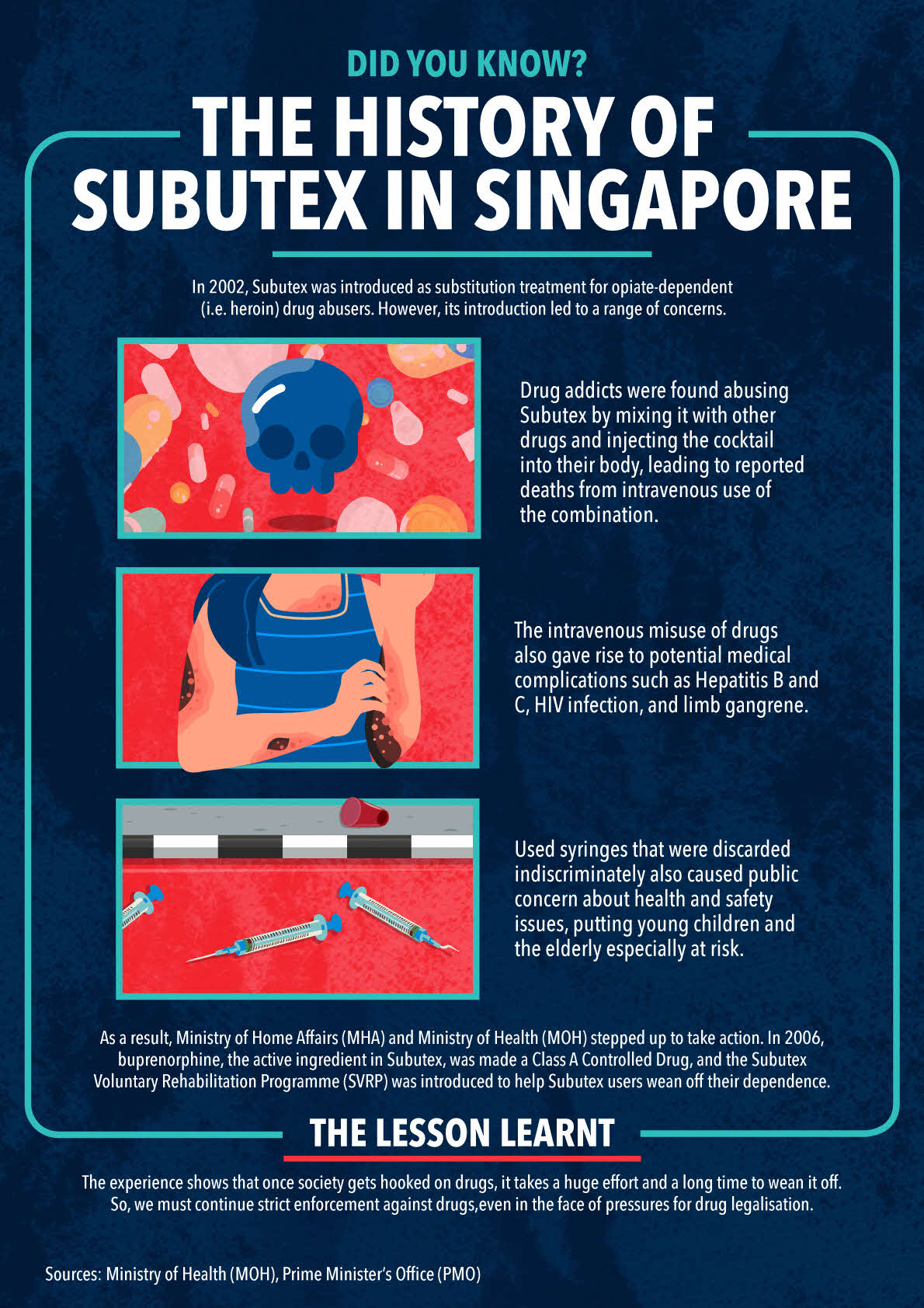
Did you know? The history of Subutex in Singapore
Many harm reduction approaches to drugs aim to promote ‘safer’ drug use, minimising but not eliminating its risks completely.
However, the reality can be complicated, as demonstrated by Singapore’s brief experience with Subutex. In 2002, Subutex was introduced as a legal prescription for treating opioid addiction. But some people started abusing Subutex as an alternative to heroin, injecting themselves to get a “high”. Within a few years, the number of Subutex abusers and Subutex-associated deaths increased significantly. At the same time, Subutex abusers were discarding their needles in public areas. Young children and the elderly were at risk of getting hurt from the needles, or worse, contracting some disease. We decided to put a stop to this. In 2006, Singapore listed Subutex as a controlled drug, and CNB mounted swift operations to wipe out Subutex from our streets.
San Francisco
In 2014, San Franscisco passed laws to reduce offence of drug possession, from a serious offence to a misdemeanour, which is to be dealt with administratively.
This change in drug policy aimed to shift drug criminalisation to treatment.
In turn, San Francisco saw a shift in the number of drug abusers using Fentanyl. The widespread issue of fentanyl has turned parts of San Francisco into open-air drug markets and homeless encampments, contributing to a record-high 810 overdose deaths in 2023, with 653 of those deaths attributed to fentanyl.
In response to this crisis, in February 2025 the city's Mayor declared a state of emergency. This measure aims to address the fentanyl epidemic by granting the city enhanced powers to tackle the issue more effectively, including the establishment of a 24/7 police-friendly stabilisation center in the Tenderloin district. The city is taking decisive action to combat the devastating effects of fentanyl on its streets and communities.
Sources: CBC, CNN, NPR, PPIC, Riley County, Sky News, The New York Times

A potentially lethal, 2mg dose of fentanyl on a pencil tip.
Additional Readings:
Fatal drug overdoses hit all-time high for San Francisco in 2023 (17 Jan 2024)
San Francisco faces deadliest year for drug overdoses due to rise of fentanyl (6 Dec 2023)
The million dollar streets strewn with bodies contorted by the effects of fentanyl (4 May 2023)
San Francisco supervisor: Drug overdose billboard sends wrong message (6 Mar 2020)
Oregon
In 2020, Oregon decriminalised the use and possession of small amounts of drugs like cocaine, methamphetamine, and heroin. Supported by 58% of voters, the policy aimed to reduce stigma and allow police to focus on other crimes while encouraging treatment for abusers.
Over the following years, the effects of the policy became increasingly apparent. Between 2019 and 2022, Oregon witnessed a significant rise in drug overdose deaths, with the number more than doubling from approximately 600 to 1,300 annually. The growing concern about public safety became evident, with residents reporting feelings of unease on the streets, and businesses beginning to leave the state in response to the deteriorating situation.
By August 2023, a majority of Oregonians had expressed support for reversing the decriminalisation measure. This shift in public sentiment culminated in 2024 when the state re-criminalised the possession of even small amounts of drugs. This reversal marks a dramatic change in Oregon's approach to drug policy.
Sources: BBC,National Review, Reuters, The Atlantic

Fentanyl hammer pipe and meth bubble pipe distributed by Outside In IDUHS as part of Oregon’s harm reduction model.
Additional Readings:
Oregon recriminalizes drug possession after overdoses rocket (3 Apr 2024)
Oregon governor to sign bill recriminalizing drug use (9 Mar 2024)
Oregon Decriminalized Hard Drugs. Now It's Reversing course. (2 Mar 2024)
Oregon lawmakers tell Gov. Tina Kotek to call state of emergency over Measure 110 (14 Nov 2023)
British Columbia
In 2023, the Canadian province of British Columbia decriminalised the possession of small amounts of drugs to reduce overdose rates. However, instead of a decline, the number of drug overdose deaths increased by more than 5% compared to the previous year. Additionally, there was public concern over the visibility of drug use in public spaces.
In response to these issues, the provincial government attempted to implement restrictions on where drugs could be consumed in public areas. However, the Supreme Court of British Columbia blocked this measure, citing concerns that limiting consumption areas could lead to drug users overdosing alone, as fewer people would be present in restricted spaces to offer assistance.
As of recent reports, the provincial authorities are exploring options to reintroduce restrictions on the public use of hard drugs as they reassess the approach to addressing the drug crisis.
Sources: BCCLA, BBC, CBC, The Economist
Additional Readings:
Success or failure? Canada’s drug decriminalisation test faces scrutiny (30 Mar 2024)
Court injunction against law banning public drug use disappointing, say police chiefs (2 Jan 2024)
Thailand
In 2018, Thailand became the first country in Southeast Asia to decriminalise cannabis for medicinal use and research purposes. In 2022, the Thai government expanded this policy to permit general cultivation and consumption, aiming to reduce prison overcrowding (with 80% of the country’s prisoners incarcerated for drug-related offences) and support rural economies through local hemp production.
This shift led to the opening of tens of thousands of cannabis-related businesses, with cannabis-infused products appearing in everyday items such as snacks and toiletries.
In the months following the policy change, the number of individuals seeking assistance for cannabis-related issues increased. Some cannabis products were unintentionally consumed by minors, pregnant women, and breastfeeding women. Although the law restricts cannabis use and sale for those under 20, there were reports of underage use in some instances.
In light of these developments, the Thai government is now considering further steps to refine its cannabis policies and ensure more effective regulation.
Sources: Nikkei Asia, Reuters, The Nation, TIME, TODAY Online
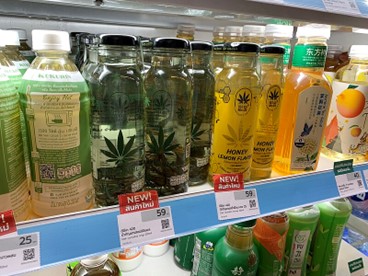
Cannabis drinks sold at a convenience store in Bangkok, 2023
Additional Readings:
Thailand to ban recreational cannabis use by year-end, health minister says (29 Feb 2024)
Photos of kids as young as 9 smoking cannabis on Pattaya Beach spark outrage (6 Dec 2022)
Five teens, 3-yr-old girl suffer from cannabis side effects: doctor (29 Jun 2022)
Ecuador
In 2014, Ecuador decriminalised the personal use, possession, and consumption of small amounts of narcotics, aiming to address drug abuse as a public health issue. The policy focused on the treatment and rehabilitation of individuals with substance use disorders.
Since the policy change, Ecuador has seen an increase in drug-related crimes, including kidnappings and homicides coinciding with rising demand for cocaine. The number of killings in the country rose from 4,500 in 2022 to 8,008 in 2023, and by January 2024, Ecuador had the highest murder rate in Latin America.
The proportion of Ecuadorians with secure employment has decreased, from 50% ten years ago to 34% today.
The drug-related situation has also impacted younger populations, with some children becoming involved in criminal activities. These activities have included drug sales, collection of extortion payments, and involvement in violent acts.
Healthcare professionals have observed an increase in anxiety and panic attacks among young people, reflecting the broader societal impacts.
Sources: BBC, CBS News, Reuters, The Economist, The New York Times, UN DCO
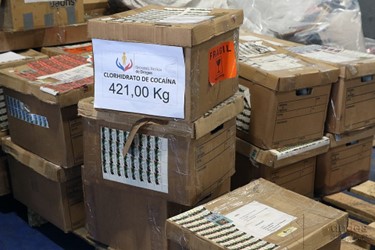
A seized shipment of cocaine, 2017
Additional Readings:
How Ecuador went from tourist haven to a nation in the grip of gangs (10 Apr 2024)
Ecuador copes with rising violence and organized crime (18 Jan 2024)
Drug traffickers groom children as young as 10 at “school of assassins” in Ecuador (16 May 2022)
Additional readings
Colorado:
Colorado among the worst states in the country for drug use, study says (3 May 2023)
Driving high in Colorado still a problem 10 years after legalization (20 Apr 2023)
New York:
Latin America:
Mexico probes 15 reported kidnappings in cartel hotspot (23 Mar 2024)
Land of no return: the Mexican city torn apart by cartel kidnappings (13 May 2023)
Booming cocaine trade now stains most of Latin America (25 Aug 2022)
Antwerp:
‘Europe’s got a problem’ – Drug violence grips Belgium’s second city (7 Sep 2023)
Outrage over girl’s ‘drug war’ death as Belgium’s cocaine haul breaks records (10 Jan 2023)